








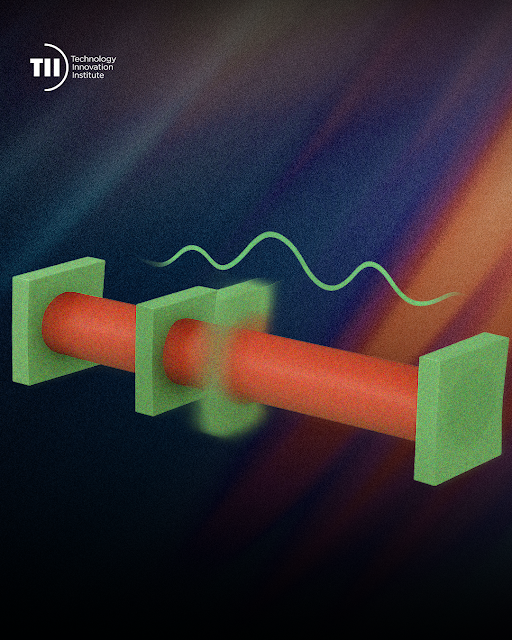
International Team Observes Shapiro Steps in Ultracold Atomic Circuits for the First Time
Florence (Italy), Kaiserslautern (Germany), Abu Dhabi (UAE) – Monday 15 December: In a major advance for quantum science, an international team of researchers has achieved the first-ever observation of Shapiro steps in ultracold atoms. This milestone offers a new window into quantum mechanics in real time and lays the groundwork for advanced quantum sensors and quantum simulation.
The findings highlight how quantum effects at the microscopic level can influence and be harnessed in large-scale systems - an idea at the core of the 2025 Nobel Prize in Physics.
Two experimental teams, one from LENS, CNR-INO, the University of Florence and the UNAM in Mexico and one from the RPTU University Kaiserslautern-Landau have observed Shapiro steps in ultracold quantum gases, following the protocol developed at the Technology Innovation Institute (TII) in Abu Dhabi, the University of Hamburg and the University of Catania. Their findings could form the foundation for next-generation quantum sensors. These devices provide proof-of-concept for pressure standards, with the potential to outperform the existing technologies.
The findings were published in two ‘back-to-back’ articles in Science, an editorial format reserved by the journal for results considered particularly significant.
“We’re seeing quantum coherence unfold in a way that has never been directly observed before,” said Dr. Vijay Singh, first author of the theoretical proposal, co-author of both experimental demonstrations, and Senior Researcher at TII’s Quantum Research Center. “This level of control opens powerful new possibilities for quantum technologies and specifically quantum simulation of superconducting circuits in conditions that were not accessible before.”
A New View of Quantum Synchronization
In conventional electronics, Josephson junctions allow supercurrents to pass with zero resistance - an essential mechanism in quantum computing and sensing. But until now, the quantum phenomenon known as Shapiro steps, quantized responses that occur when the system is driven by an external oscillation, had only been observed in superconducting circuits.
By recreating this effect with ultracold atoms, scientists can now slow down and magnify the inner workings of quantum systems, making the invisible visible.
In the experiments, one led by Dr. Giacomo Roati of LENS and CNR-INO's research group in Sesto Fiorentino, and one led by Professor Herwig Ott at the RPTU University Kaiserslautern-Landau, each oscillation of the system generated precise numbers of miniature whirlpools, called vortex–antivortex pairs, or vortex rings. These were responsible for producing the step-like signals observed.
“Using ultracold atoms is like watching quantum mechanics in slow motion,” said Dr. Giulia del Pace, first author of the Florence experiment. “We finally have a way to observe the fine details of quantum coherence that were previously hidden from view”, adds Dr. Erik Bernhart, first author of the Kaiserslautern experiment.
"During one oscillation period of the current, a number of vortex-antivortex pairs is emitted by the junction, consistent with the order of the Shapiro step. These introduce the necessary phase jump into the system for the junction to develop the potential difference of a Shapiro step," explains Dr. Giacomo Roati, senior author of the experimental demonstration in Florence and Director of Research at CNR-INO.
“This is the first time we’ve seen quantized Shapiro steps in an atomic system and directly tied them to the emission of vortex rings,” said Professor Herwig Ott, senior author of the experimental demonstration at Kaiserslautern. “This discovery not only deepens our understanding of quantum transport but also advances atomtronics toward becoming a practical platform for future quantum technologies”, emphasizes Professor Ludwig Mathey from the University of Hamburg and co-author of the Kaiserslautern experiment.
Atomtronics, short for atomic electronics, is an emerging field where neutral atoms, guided by lasers, mimic the roles of electrons in traditional circuits. However, unlike electrons, these neutral atoms offer greater control and coherence, offering new capabilities in quantum engineering. Atomtronic devices promise ultra-sensitive measurements of gravity, rotation, and magnetic fields, enabling future applications in autonomous navigation, seismic monitoring, and space-based exploration.
Professor Luigi Amico, Executive Director of Physics at TII’s Quantum Research Center, senior author of the protocol and co-author of both experimental demonstrations, explained: “We’ve built the first atomtronic AC circuit using neutral atoms instead of electrons. This creates a new class of devices for measuring subtle forces and fields with unprecedented resolution. From quantum compasses to gravity detectors, the real-world applications are significant”.
Professor Leandro Aolita, Chief Researcher of the Quantum Research Centre at TII comments: “This achievement reflects the international relevance of Quantum Research Centre in the field and exemplifies the power of international scientific collaboration in advancing quantum research”.
By uniting theoretical and experimental expertise across leading institutions, the work delivers a new platform for studying quantum coherence in real time - offering a concrete foundation for future quantum sensing technologies.
More information about the findings can be read on Science:
- Shapiro steps in strongly-interacting Fermi gases: https://www.science.org/doi/10.1126/science.ads8885
- Observation of Shapiro steps in an ultracold atomic Josephson junction: https://www.science.org/doi/10.1126/science.ads9061