


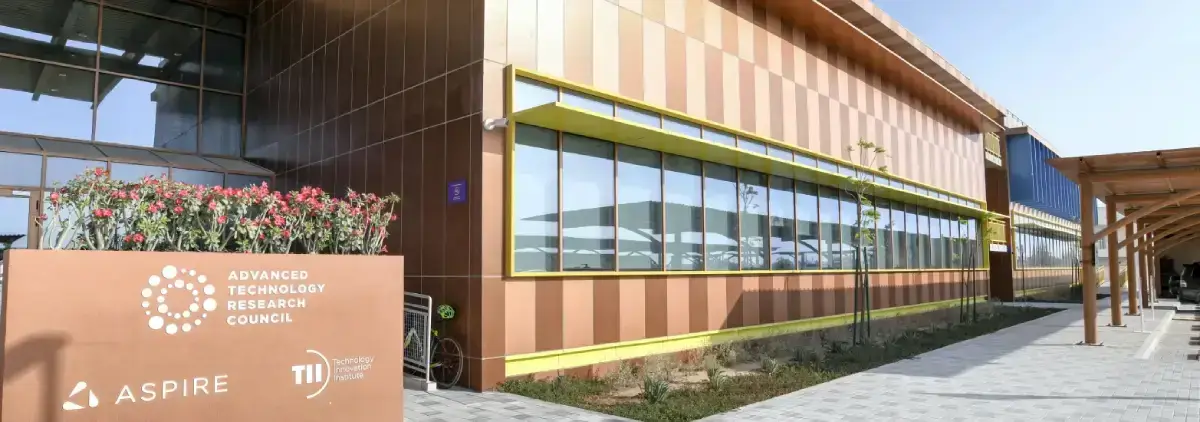




Abu Dhabi, UAE – March 17, 2026: The Technology Innovation Institute (TII), the applied research arm of Abu Dhabi’s Advanced Technology Research Council (ATRC), in collaboration with NVIDIA, announced the successful demonstration of large-scale numerical simulations of the adiabatic quantum annealing (QA) algorithm for problem instances involving up to 500,000 qubits.
Adiabatic quantum annealing is the gold-standard quantum algorithm for solving combinatorial optimization problems, which are computationally challenging and widely encountered across many industries.
The TII-NVIDIA collaboration builds on recent theoretical advances from TII in tensor-network contraction using belief propagation, combined with a custom compilation approach employing cuTENSOR to enable efficient parallelization and deployment of inference algorithms with NVIDIA accelerated computing. The simulations reproduce the complex entanglement-generating dynamics driven by deep QA circuits while delivering verifiable solutions to real-world optimization problems on low-connectivity graphs, with performance benchmarked against all heuristic solvers in the MQLib repository (https://github.com/MQLib/MQLib); a widely used library for combinatorial optimization benchmarking.
The largest problems simulated correspond to QA circuits that solve quadratic unconstrained binary optimization (QUBO) problems on 500,000 qubits and contain a total of a 1.5 x 10 9 two-qubit entangling gates. For these instances, TII’s simulator achieved solution quality exceeding that of all solvers evaluated from MQLib.
The emulator is accessible to external users via an experimental cloud platform hosted at https://q-inspired.tii.ae , developed by TII’s Quantum Research Center (QRC). External users can submit quantum annealing tasks in the following ways:
- Web interface: Users upload a quantum annealing instance specification in JSON format.
- Python client: Users can programmatically construct the problem specifications and submit them directly to the cloud from a Python script or an IPython notebook.
The collaboration demonstrates the practical impact of combining advanced algorithmic theory with GPU-accelerated infrastructure and powerful software implementations. It enables industry and academic partners to explore quantum annealing applications at scales beyond those currently achievable with near-term quantum hardware, expanding the range of complex optimization problems that can be investigated using quantum-inspired approaches.