







A landmark moment from experiment to aerospace infrastructure
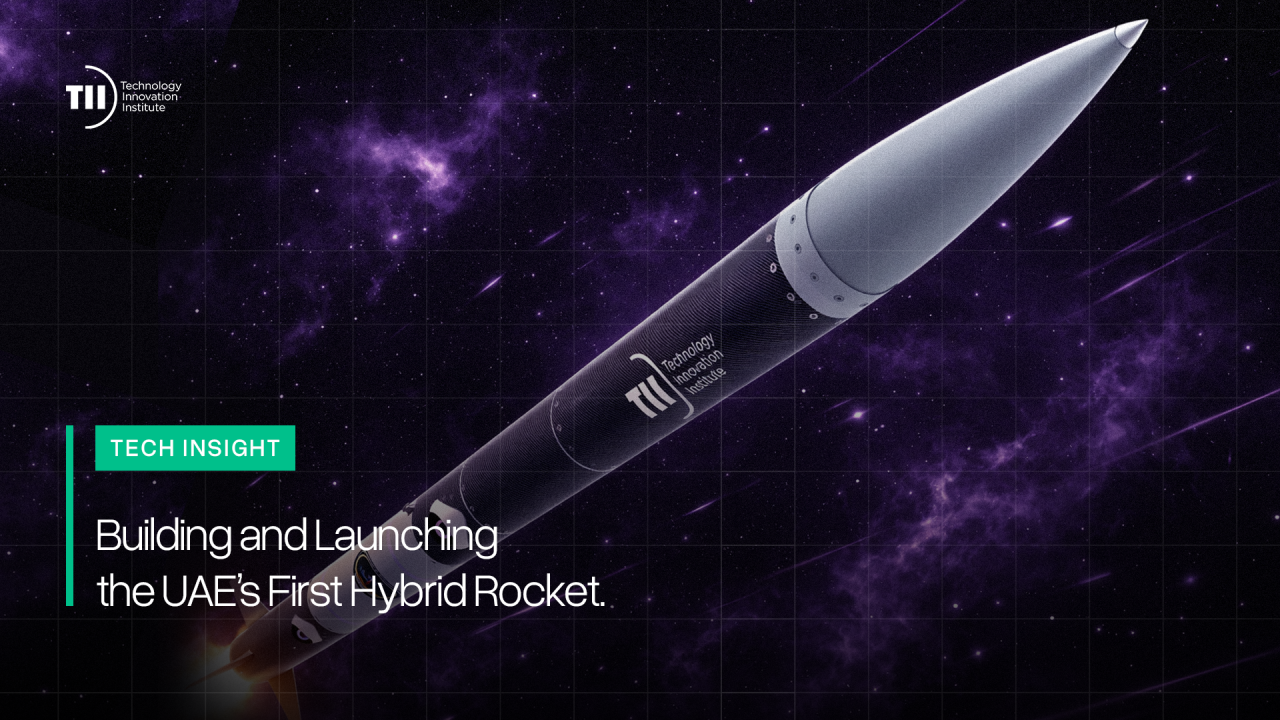
There are moments in a country’s technological journey that shift the baseline of what is possible. The hybrid rocket project developed by the Technology Innovation Institute (TII), is one of those defining moments. Not because a rocket flew — it’s done that before — but because this time, it represented something more: a fully integrated, locally developed propulsion and manufacturing capability working as one system. This project demonstrates that complex aerospace systems can now be designed, built, tested, integrated, and launched end-to-end in the UAE.
At the heart of the project is a hybrid propulsion system, combining elements of both solid and liquid rockets. Hybrid rockets are safer to handle, simpler to operate, and well-suited to sounding rocket missions and technology demonstration, making them a strategic steppingstone for future aerospace capability.
Propulsion hardware alone does not create aerospace capability.
The most recent campaign focused on closing the gap between validation and operational reality.This included a structured readiness program with cold-flow testing, hot-fire tests, vertical static firings, and launch-gantry rehearsals, ensuring that hardware, software, and operators were all prepared for flight-like scenarios.
“By treating each flight as a data-gathering and learning opportunity, we are steadily establishing a validated flying propulsion test bed that can be scaled toward higher altitudes and larger hybrid motors,” Amna Alhosani, researcher in rocket propulsion, Propulsion and Space Research Center, says. “This launch represents a major milestone for the UAE. It is the first time a hybrid rocket has been launched from the country, and more importantly, it was designed, built, and operated locally.”
In a sounding rocket, the avionics is the “nervous system” of the vehicle: it senses the flight state, makes decisions in real time, and commands critical events such as recovery deployment.
“For this mission, we implemented a dual-computer architecture. A primary flight computer manages all safety- and mission-critical functions, including state detection, apogee determination, GPS tracking, and parachute deployment.” Aijaz Khan, Senior Engineer, Rocket Systems, says. “In parallel to that, an independent microcontroller handles high-rate acquisition of pressure and temperature data acquired in the propulsion unit, and transmits key parameters to the ground station, while logging everything onboard for post-flight analysis.”
The successful flight now provides a validated baseline. With real mission data in hand, TII is already progressing toward the next vehicle, targeting higher altitudes — a critical step toward more advanced sounding rocket missions.
With multiple campaigns completed, the hybrid rocket project has moved beyond proof-of-concept status. It now functions as a national testbed, a platform for propulsion refinement, materials research, structural validation, and mission architecture development.
The roadmap ahead includes higher altitudes, larger hybrid motors, and expanded sounding rocket capability.
Sovereign capability is built through the steady accumulation of verified performance, not a single breakthrough. This project marks the point where the UAE is not only launching hardware, but maturing aerospace infrastructure.