







By Dr. Jennifer Simonjan, Senior Director, Technology Innovation Institute
One thing I’ve learned after years of working in robotics is this: even the most advanced autonomous system is only as good as its communication link. We tend to focus on the exciting parts—drones, sensors, AI, and autonomy. But when a mission doesn’t go as planned, the root cause is often something far less glamorous: the communication link. Too short in range. Too heavy to carry. Too expensive to scale. In real-world operations, communication is always one of the bottlenecks.
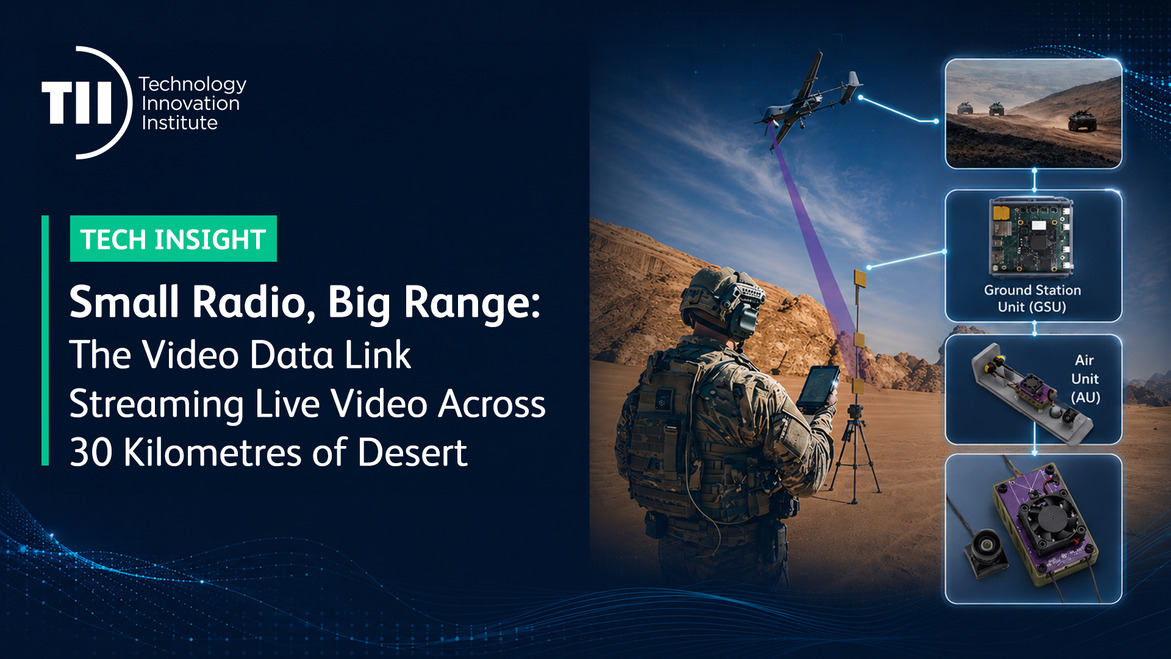
That is the challenge our team at the Technology Innovation Institute (TII) set out to solve. The result is our Video Data Link (VDL): a lightweight communication system capable of transmitting high-definition video and control data over distances of more than 30 kilometres, even in the extreme heat of the desert. Despite its performance, the device is very compact. It’s about the size of a matchbox, weighs just 60 grams, and can be produced for less than $200.
Comparable tactical radios typically cost thousands. Ours costs about as much as a good pair of headphones. That fundamentally changes what's possible.
An end-to-end link in two small boxes
The system is elegantly simple. On the aircraft sits the Air Unit, a tiny module measuring 60 by 36 by 20 millimetres that captures and encodes high-definition video from an onboard camera and forwards it, together with telemetry from the flight controller, over a long-range radio link. On the ground, a pole-mounted Ground Station Unit receives and decodes the stream, outputting low-
latency 720p video at up to 90 frames per second to any standard display or first-person-view goggles.
The numbers matter here. With a latency of around 55 milliseconds, the video feed is responsive enough for a pilot to fly comfortably in first-person view. With a directional ground antenna, the system achieves communication ranges of more than 30 kilometres. We’ve successfully tested it under real-world conditions, where it delivered reliable performance even in the extreme heat of
the UAE desert — a very harsh operating environment.
Why cost is a feature, not a footnote
It is tempting to treat price as a commercial detail rather than an engineering achievement. At TII, we see it differently. In robotics, cost determines scale, and scale determines what missions are possible.
Consider a swarm of tens of drones surveying infrastructure, supporting search and rescue, or mapping terrain after a disaster. Every single aircraft needs its own communication module. At thousands of dollars per radio, the economics collapse before the mission begins. At under 200 dollars per unit, entire fleets become affordable.
The same logic applies to high-risk operations, where aircraft fly into environments they may not return from: hazardous inspection, disaster response, or operations over unforgiving terrain. When hardware is genuinely expendable, missions can be flown that would not be risked with premium equipment on board.
Designed around the real problems of robotics
VDL exists because robotic applications come with a very specific set of communication challenges that general-purpose radios were never designed for. Autonomous ground vehicles and drones need to talk over long distances. Many missions require live video streaming or direct pilot control. Small drone platforms are severely restricted in payload, which rules out large tactical radios entirely. And as fleets grow, communication becomes the major bottleneck: you need many modems, preferably cheap and lightweight, capable of networking together.
We designed for all of it at once. The result is a rare combination: lightweight, long-range, and low-cost in a single system. Each of those qualities exists elsewhere in the market. To our knowledge, nothing else combines all three.
Sovereign, open, and configurable
There is one more quality that is just as important: the software is fully accessible and configurable. Teams can adapt the system to meet specific mission requirements, from point-to-point links to broadcasting topologies that control multiple airborne platforms at once. The system can even be virtualized on existing Linux-based hardware, requiring only the radio modules themselves.
For the UAE, this openness carries a deeper significance. A communication technology developed here, understood down to its source code, and tailorable to any application is a sovereign capability, not a dependency.
What comes next
We are not finished. Our next steps focus on mesh networking, allowing units to relay traffic through one another for robust coverage at low altitudes and across complex terrain, and on extending the security features built into the link. Both bring us closer to the vision this project has always served: making reliable, long-range communication so practical and so affordable that it stops being the bottleneck.
Dr. Jennifer Simonjan is a Senior Director at the Technology Innovation Institute in Abu Dhabi, where her teams develop communication, airspace management, and autonomy technologies for next-generation robotic systems.