








As cyber threats continue to evolve, it is becoming clear that security outcomes depend on much more than intelligence alone. Increasingly, the focus is shifting toward the systems that can turn intelligence into action.
Consider a vulnerability disclosed at midnight. By the time the team reads the alert at 9 a.m., an autonomous system has already mapped the organization’s exposure, validated which assets are truly at risk, prioritized remediation actions, and opened the necessary tickets. No analyst lost a night's sleep. This is no future vision. Early versions of this capability are already emerging.
For years, we have judged AI in cybersecurity by one thing: how well the model performs. But detection was never the whole job. What actually consumes a security team's day is everything that comes after the alert: gathering the evidence, working out the context, pulling the right tools together, deciding what matters most, and standing behind the call. Those are not separate chores. They are a workflow, and the workflow is what agentic platforms are starting to change.
It helps to remember how we got here. For most of its history, AI in cybersecurity has focused on improving detection. Machine learning surfaced patterns in vast amounts of security data, deep learning improved the accuracy of malware and intrusion detection, and more recently large language models made it possible to analyze unstructured information such as threat reports and system logs [1]. Each generation made security teams better at recognizing problems, but the work around that task — the investigating, the connecting of dots, the actual response — remained largely manual [2]. We made analysts faster at noticing problems and then left them to solve the problems alone.
Vulnerability management shows why this matters. Many organizations already run mature tools to identify vulnerabilities across endpoints, cloud environments, applications, containers, and infrastructure. Finding vulnerabilities is rarely the problem. The harder task is moving each finding through its full lifecycle, from discovery to reporting, while keeping context intact across every handoff. Each stage depends on information generated by the previous one while creating new context for the next, drawing in security teams, infrastructure teams, developers, application owners, ticketing systems, scanners, and threat intelligence platforms.
Maintaining that context across people, tools, and decisions is often harder than finding the vulnerability itself. In other words, vulnerability management is more a coordination problem, than a detection problem.

Three pressures make that coordination heavier every year: overwhelming alert volumes, an ever-expanding attack surface (as software now ships continuously and every release adds more weaknesses to the pile [6]), and a global shortage of cybersecurity professionals. Together, they make it increasingly difficult for human analysts to keep pace, and a more capable model does not fix any of this. A better model may give a better answer, but a better answer is not the same as a resolution. Detection identifies risk. Agentic platforms manage it.
Rather than simply producing an output and stopping, agentic platforms coordinate tools, data, and specialized workflows to reason, plan, and act towards an operational goal — and keep coordinating until that goal is met.
What makes this possible is not the model alone; it is the system around it. Agentic platforms break complex objectives into manageable tasks, retain context as work progresses, interact with tools and data sources, and verify results before acting. Verification may be the most important capability of all. The better systems do not produce a finding and walk away; they challenge their own conclusions, look for supporting evidence, and test whether a result holds up before acting on it. Some approaches even use multiple agents to evaluate the same problem from different perspectives, treating disagreement as a signal that further validation is needed [4].
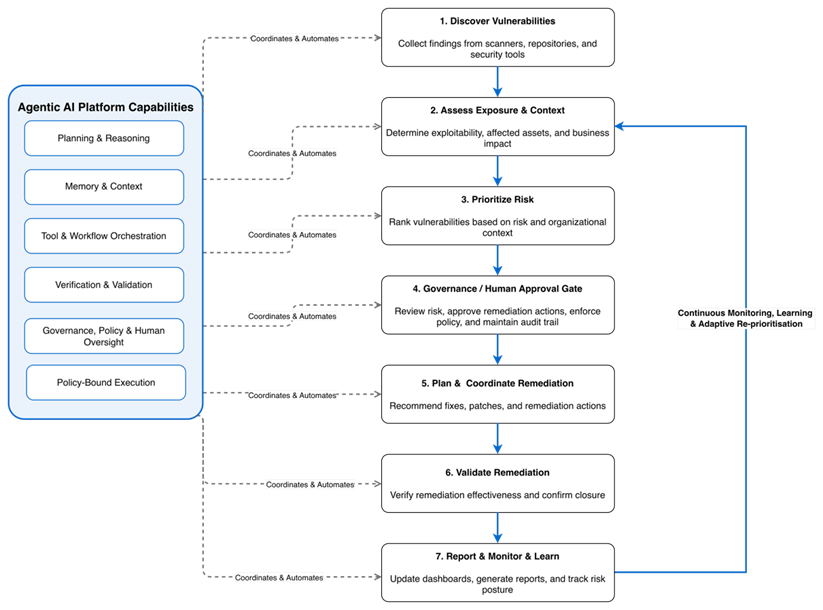
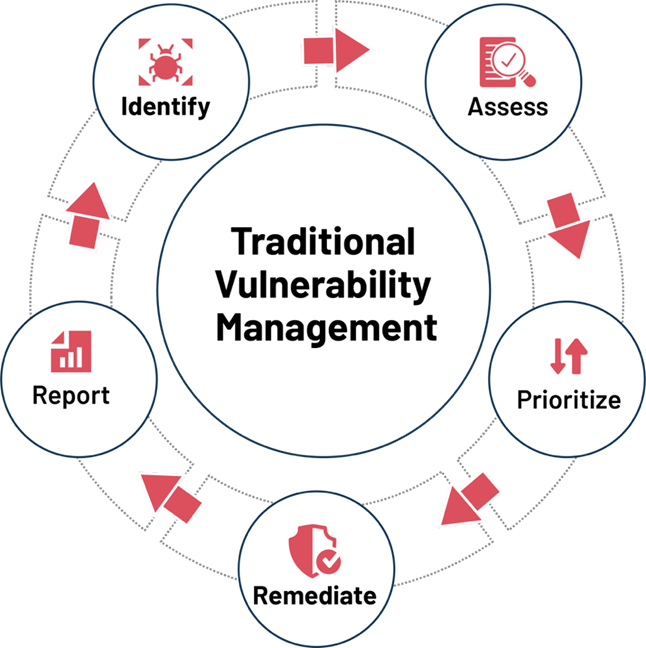
Consider a critical vulnerability affecting hundreds of servers. A traditional scanner does its job and generates hundreds of alerts, but from that point on the burden falls largely on people. Security teams must work out which systems are actually exposed, understand the business impact, decide what needs fixing first, verify that remediation was successful, and keep stakeholders informed throughout the process.
An agentic platform approaches the same problem as a single coordinated workflow, maintaining context, updating priorities as new information becomes available, validating remediation outcomes, and tracking progress until the issue is resolved. The value is not simply that vulnerabilities are discovered faster. It is that organizations can move more efficiently from discovery to genuinely reduced risk, rather than leaving findings stranded between teams, tools, and ticket queues. And because a validation step distinguishes real issues from false alarms, it goes straight at the noise and mistrust that have long dodged automated security tools, cutting alert fatigue and giving teams reason to act on the output.
Trust, however, remains one of the biggest challenges for agentic cybersecurity systems. An autonomous agent can be misled by incomplete information, manipulated inputs, or even adversarial prompts designed to steer its decisions. And while automation can accelerate response, a wrong action, such as applying the wrong patch, changing a critical configuration, or isolating an important system, can be just as disruptive as the vulnerability itself.
Trustworthy agentic platforms are therefore not defined by autonomy alone. They rely on safeguards such as verification mechanisms, audit trails, clear operational boundaries, and human oversight for high-impact decisions. The goal is not to replace human judgement, but to support it, ensuring that autonomous actions remain transparent, accountable, and aligned with the organization's tolerance for risk.
This shift is beginning to reshape cybersecurity research itself. For years, the focus was on improving detection accuracy, classification performance, and model capability. Increasingly, the question is no longer whether a model can identify a vulnerability, but whether a system can manage the entire process from discovery and prioritisation to remediation and validation in a trustworthy and repeatable way.
Vulnerability management is only the beginning. Similar agentic workflows are already emerging across threat hunting, incident response, malware analysis, compliance monitoring, and cloud security operations. As these systems take on more responsibility, the role of security professionals is likely to shift from performing repetitive investigations to supervising, validating, and directing increasingly capable AI-driven workflows [7].
The next phase of cybersecurity will not be defined solely by more capable AI models. It will be defined by systems that can transform intelligence into action, bringing together planning, memory, verification, tool integration, and autonomous execution to address challenges that detection alone could never solve. As cyber threats continue to grow in scale and complexity, the organizations that succeed will be those that can continuously identify, prioritize, validate, and manage risk through trustworthy systems that reason, decide, and act.
At Technology Innovation Institute (TII), this vision is already shaping our research. Within the Cryptography Research Center (CRC), we are exploring agentic AI platforms that can coordinate the vulnerability management lifecycle, from discovery and prioritization to remediation and validation, with an emphasis on trust, accountability, and repeatability. Working alongside research partners and the wider cybersecurity community, our goal is to advance intelligent security platforms that do more than identify risk. These platforms should enable organizations to manage risk continuously and at scale.
Reference
[1] N. Kshetri, "Transforming cybersecurity with agentic AI to combat emerging cyber threats," Telecommunications Policy, vol. 49, no. 5, 102976, 2025. https://www.sciencedirect.com/science/article/pii/S0308596125000734
[2] NVIDIA, "Advancing Cybersecurity Operations with Agentic AI Systems," NVIDIA Technical Blog, 2025. https://developer.nvidia.com/blog/advancing-cybersecurity-operations-with-agentic-ai-systems/
[3] Precedence Research, "Artificial Intelligence (AI) in Cybersecurity Market Size to Hit USD 167.77 Bn by 2035," 2025. https://www.precedenceresearch.com/artificial-intelligence-in-cybersecurity-market
[4] Microsoft Security, "Defense at AI speed: Microsoft's new multi-model agentic security system tops leading industry benchmark," Microsoft Security Blog, 2026. https://www.microsoft.com/en-us/security/blog/2026/05/12/defense-at-ai-speed-microsofts-new-multi-model-agentic-security-system-tops-leading-industry-benchmark/
[5] The Hacker News, "From Assistive to Agentic: The AI Shift That's Redefining Threat Management," 2026. https://thehackernews.com/2026/06/from-assistive-to-agentic-ai-shift.html
[6] V. Saravanan, "Closing the Loop: Agentic AI for Continuous Vulnerability Detection, Validation, and Remediation" International Journal of Artificial Intelligence, Data Science, and Machine Learning, vol. 7, no. 1, pp. 255-259, 2026. https://ijaidsml.org/index.php/ijaidsml/article/view/467/
[7] M. Leo, F. Tan, T. Miao, and G. Anand, "From threat to trust: assessing security risks of agentic AI systems," International Journal of Information Security, vol. 25, no. 23, 2026. https://link.springer.com/article/10.1007/s10207-025-01185-y
[8] CyberSecurity Insiders, "Embracing Advanced Frameworks for Effective Vulnerability Management." https://www.cybersecurity-insiders.com/embracing-advanced-frameworks-for-effective-vulnerability-management/
[9]NIST, "National Vulnerability Database (NVD) – Search and Statistics." https://nvd.nist.gov/vuln/search#/nvd/home?resultType=statistics
Reference links: