






Researchers at the Advanced Materials Research Center have developed a reflective radiative cooling coating that reduces peak surface temperatures by double-digit degrees Celsius and can be applied to existing surfaces using conventional painting techniques.
Author
Air conditioning accounts for roughly seventy percent of peak summer electricity demand across the Gulf. To reduce energy consumption and associated costs, most engineering efforts have focused on improving air-conditioning systems: better compressors, smarter thermostats, and more efficient refrigerants. Comparatively little attention goes to keeping the heat out in the first place. Consider instead a surface that absorbs less solar energy and emits more thermal radiation toward the sky.
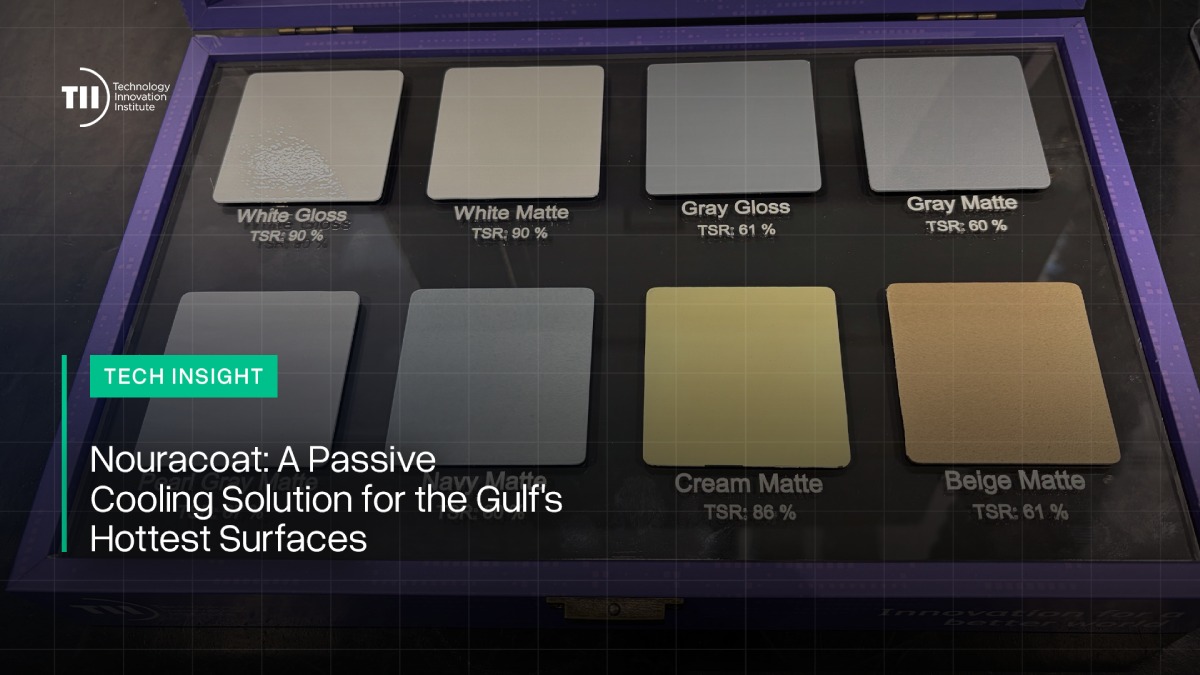
NouraCoat is a passive radiative cooling system developed by AMRC: a composite coating engineered to reflect sunlight across the solar spectrum and to emit radiation efficiently in the atmospheric window where a warm surface naturally sheds heat to the cold sink of outer space. This cooling effect requires no refrigerant, no moving parts, and no electrical input. NouraCoat can be applied using conventional spray or roller techniques at ambient temperature, without specialized curing processes or modifications to the underlying substrate. The rationale is straightforward: for a coating to achieve widespread adoption, it must be compatible with existing application practices and accessible to the professionals who already paint and maintain roofs.
An optional phase-change layer sits under the reflective coat where thermal mass matters, absorbing heat during the day and releasing it overnight to flatten the swing in surface temperatures.
In testing, NouraCoat demonstrated surface temperature reductions of up to 27°C compared with uncoated reference surfaces under identical conditions. In addition to its thermal management performance, NouraCoat provides anticorrosive protection, offering dual functionality in a single coating solution. Early deployments have concentrated on fleet vehicles, shipping containers, outdoor equipment enclosures and public infrastructure, including bus shelters and transformer housings.
Two environmental challenges specific to the UAE’s climate are key areas of ongoing research. The first is dust accumulation, which can reduce the coating’s ability to reflect sunlight and maintain its cooling performance. Understanding how quickly dust affects performance is essential for determining how often the coating needs to be cleaned or maintained to remain effective over time. We are developing advanced surface formulations that minimize dust accumulation and help maintain the coating’s performance over time. The second is long-term weathering. The coating has to maintain its optical properties over years of intense UV exposure, thermal cycling, and humidity in a climate harsher than the ones in which most radiative cooling data have been generated. Early deployment data will help build this evidence base.
NouraCoat is part of AMRC’s broader research efforts to address a fundamental challenge: how advanced materials and surface technologies can help reduce the Gulf’s growing demand for cooling. While a well-engineered coating cannot replace air conditioning, it can significantly reduce the heat absorbed by exposed surfaces, helping lower the cooling demand on air-conditioning systems and potentially reducing energy consumption.