





When we think of national safety, our minds often turn to cybersecurity or defense. Yet the strength of our infrastructure such as roads, bridges, power plants and buildings, are just as vital to keep people safe.
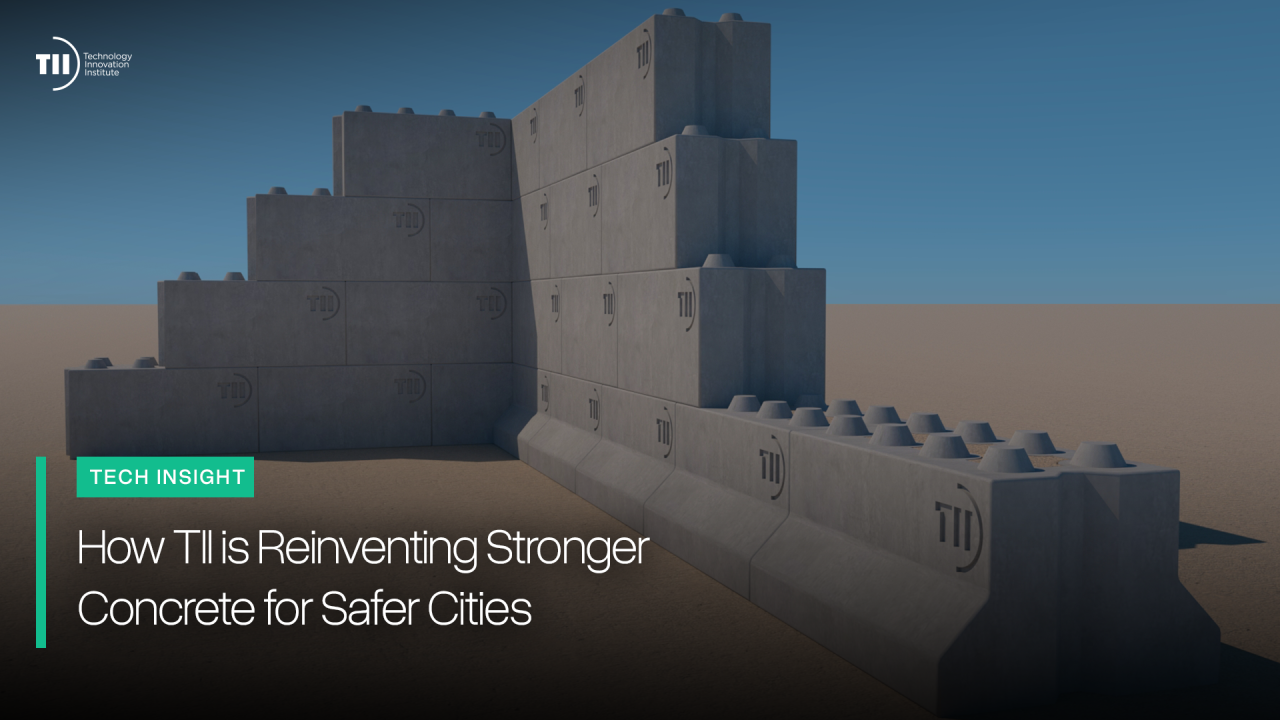
At the Technology Innovation Institute (TII) in Abu Dhabi, researchers have developed a new class of high-performance concrete, designed with locally available materials and tailored to the UAE’s specific needs, to make infrastructure more resilient against impact.
This is the first research of its kind in the MENA region, and it has already achieved remarkable results. Compared to standard concrete used in the UAE, the TII-designed material has shown a 48% increase in resistance under impact loading.
The motivation behind this research is clear: to keep people safe. Stronger, more reliable infrastructure means fewer disruptions to essential services like water and power, more resilient roads and bridges, and safer buildings in the event of unexpected catastrophes.
Beyond safety, high-performance concrete can help reduce damage costs for cities and governments, supporting more sustainable and manageable urban management.
TII’s innovation helps create a safer country as well as a more prepared and financially resilient one.
Behind the science
At its core, the project improves the way raw materials like cement, sand, and stone are combined to produce stronger and more durable concrete. These new mixes can be applied both to reinforce existing structures and to create new, safer designs.
To ensure that the improved concrete is efficient against impact scenarios such as vehicle crashes, explosions, and earthquakes, scientists at TII conducted full-scale tests using ultra-high-speed cameras and 3D scanners to capture every crack as it formed. Impact trials, including high-velocity tests with advanced equipment like the Split-Hopkinson Pressure Bar and Gas Gun Launcher, showed how the material performed under extreme stress.
Technology played a central role. Computational simulations predicted how structures made from this high-performance concrete would behave in real-world scenarios, while microscopes and particle analyzers revealed material composition.
Developing this high-performance concrete wasn’t without challenges. The UAE’s hot summers presented a unique hurdle as to whether the new concrete mixes would stand up to extreme heat as well as high impacts. Understanding and adapting to local conditions was essential, and the team developed a solution that performs reliably even in the harsh climate.
The power of international collaboration
For TII, it is essential that progress in science and technology comes from collaborating with global partners, and work on the high-performance concrete was no exception.
Early in the project, TII partnered with international institutions to strengthen the research. One key partner was PUC-Rio (Pontifical Catholic University of Rio de Janeiro) in Brazil, which provided essential data on the compressive and tensile properties of the concrete. Their contribution helped establish a solid foundation for testing and highlighted the value of combining local expertise with international insight.
By engaging with leading universities and research centers abroad, TII is ensuring that its solutions are both relevant to the UAE and part of a broader global effort to make infrastructure safer and more resilient.
The next step in this research is to transform the high-performance concrete into products, which could be applied to everyday structural repairs and high-security facilities where resilience is non-negotiable.
The work is far from over, but the vision is clear: to create a new generation of infrastructure materials that make cities safer, stronger, and ready for future challenges.