






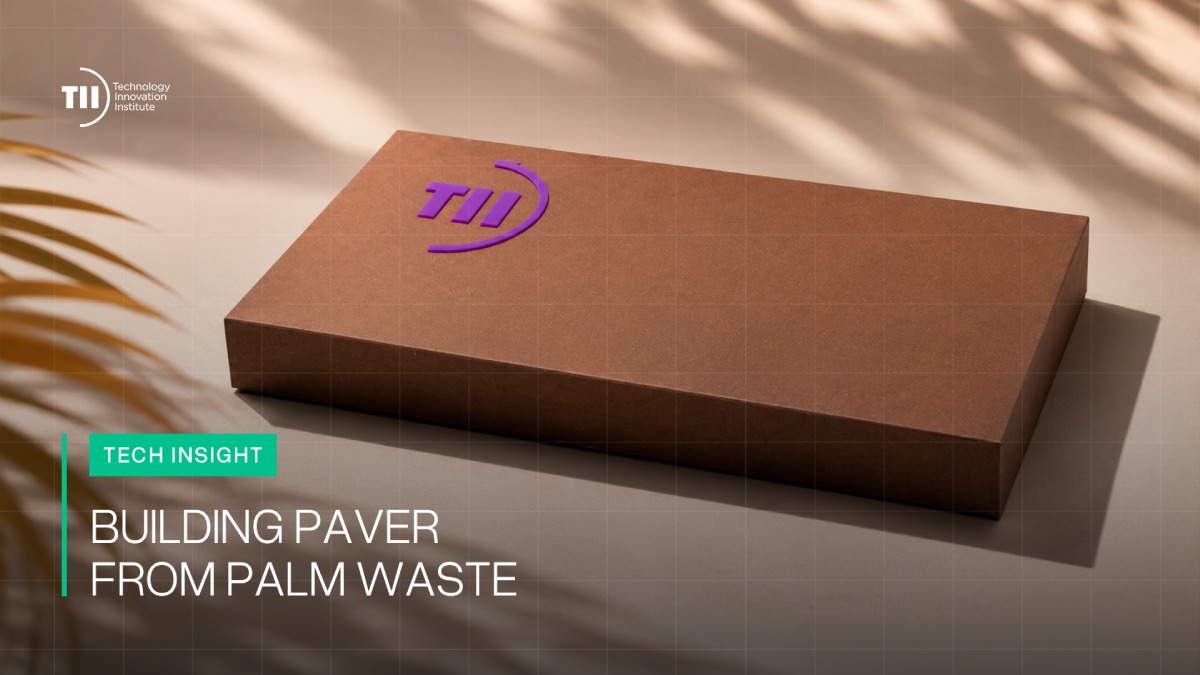
Made from more than 80% locally available, abundant natural resources and valorized waste materials, this innovative bio-composite is manufactured without the use of water or cement. It offers a resource-efficient alternative to conventional cement-based blocks, with enhanced mechanical strength and reduced weight. The next step is demonstrating its potential in real-world construction applications.
Author
The construction industry has largely treated sustainability as a design problem, relying on smart glazing, efficient HVAC and LEED-certified designs to make the finished building greener. The materials themselves have changed far less. Most remain what they were in the 20th century: cement-based, carbon-intensive, water-intensive and dependent on quarried raw materials.
The UAE generates an estimated 500,000 tonnes or more of date palm waste each year, much of it burned on farms or sent to landfill. The chemistry for turning plant biomass into building materials is well established. What remained obscure so far was whether a composite made from this particular waste stream could perform as a credible structural material.
Where bio-based materials fell short
Bio-based building materials have historically fallen short on performance, most often on moisture resistance or strength. Straw bale construction, revived since the 1990s, is vulnerable when bales are exposed to groundwater or water vapor without a properly detailed render: they can decay from the inside, and the damage often goes unnoticed until the wall is already compromised. Cross-laminated timber, the flagship of modern mass-timber construction, is sensitive to wetting before the building envelope is closed, which can lead to swelling, checking and, in some cases, delamination. Hempcrete, made by mixing hemp shiv (the woody core of the plant stem) with a lime-based binder, has a different limitation: its compressive strength is typically well below 1 MPa, adequate for insulating infill but far short of what a load-bearing wall requires.
A different approach
The palm waste is incorporated without any prior chemical treatment. The production process requires neither water nor cement and allows demolding after just two hours, significantly reducing production time compared to conventional cement-based materials. The technology is designed to be compatible with existing concrete block manufacturing equipment, facilitating easy adoption by manufacturers without major modifications to their production lines. Different formulations have been developed to accommodate various manufacturing methods, including pre-casting and more paste-like formulations suitable for conventional concrete block-making machines.
Compressive strength is around three times that of standard cement-based blocks and roughly 70 times that of hempcrete. Flexural strength is approximately six times that of conventional blocks, and the material is 20-40 percent lighter than ordinary concrete.
Water absorption is below 2 percent, compared with up to 15 percent for concrete blocks. In a region where humidity, salt-laden air and groundwater are routine stressors on buildings, that difference means fewer maintenance interventions and a lower whole-life cost. Low water uptake also supports thermal performance: the material provides roughly four times the insulating value of conventional concrete, partly because there is little moisture in its pores to conduct heat.
Designed for disassembly
The block geometry extends the sustainability case further. The blocks can be produced to interlock and are laid dry, without mortar, which shortens installation time and reduces reliance on skilled labor. More importantly, a wall built from them can, in principle, be dismantled and rebuilt elsewhere: reuse, not just recycling.
The path to adoption
The main barrier to widespread adoption is regulatory. Building codes are conservative for good reason: before a new material can carry load in a code-compliant building, it must pass independent performance testing, factory production certification and formal regulatory approval. Testing with the Abu Dhabi Quality and Conformity Council is under way.
Near-term adoption will therefore focus on non-structural applications such as cladding, facades, modular panels, flooring and urban infrastructure elements. These uses capture the embodied-carbon advantage today, within existing regulatory frameworks, while structural certification proceeds in parallel.
Beyond the palm waste
The palm waste formulation is a proof of concept for a chemistry designed to be adapted to regional feedstocks. The binder system is not tied to a specific biomass; what matters is particle geometry, cellulose content and compatibility with the polymer. Rice husk in Egypt, oil palm residue in Malaysia and banana stem waste in Indonesia are all candidate feedstocks, each yielding a composite tuned to local resources.
Regulation of embodied carbon in construction is tightening. The European Union, for example, will require whole-life carbon to be calculated and disclosed for large new buildings from 2028 and for all new buildings from 2030. As comparable requirements emerge in the region, the materials specified into UAE buildings will be those already certified and in production. The raw material for ours is on the ground today, and relevant products in certification phase.