






How TII is transforming recycled plastic and industrial wood waste into carbon-negative polymer composites
Abstract
Global plastic production exceeded 400 million tons in 2022 with the vast majority derived from fossil fuel feedstocks. Even the shift to recycled plastics, while a meaningful improvement, does not achieve carbon negativity. It reduces embodied carbon; it does not reverse it.
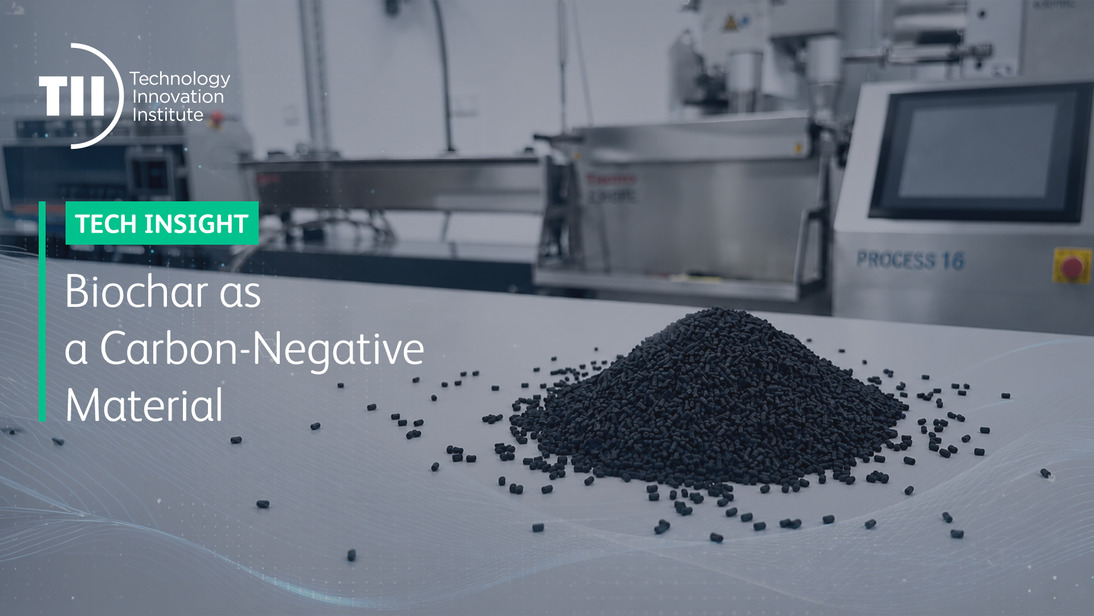
Biochar, a carbon-rich material derived from biomass through pyrolysis, offers a fundamentally different outcome. When compounded into a recycled polymer matrix, it produces a pellet whose manufacture sequesters more carbon than it emits. TII’s Advanced Materials Research Center (AMRC) has developed and validated this approach: combining recycled HDPE with biochar derived from industrial solid wood waste results in composite pellets with a verified Global Warming Potential (GWP) of - 0.41 kg CO 2 e per kilogram. This is carbon-negative by the most rigorous international accounting standards.
The innovation is not biochar itself, which is well-established as a soil amendment and carbon sink, but its incorporation into a polymer compound. Optimizing the mixture of two industrial waste streams produces a carbon-negative final product that can replace conventional or recycled plastics across a wide range of applications.
This whitepaper sets out the science behind biochar’s carbon-negativity, explains TII’s compounding approach, and presents the implications for polymer-intensive industries and the UAE’s Net Zero 2050 ambitions.
1. The Gap Recycling Cannot Close
The carbon problem in plastics
The production of virgin polymers is energy-intensive and carbon-heavy. Manufacturing one kilogram of virgin HDPE generates approximately 1.9 kg of CO 2 equivalent — accounting for the extraction, refining, and polymerization of petroleum-based feedstocks. Globally, plastic production is responsible for an estimated 1.8 billion tons of CO 2 equivalent per year, a figure that continues to rise as demand grows across construction, logistics, packaging, and consumer goods.
The shift toward recycled plastics represents meaningful progress. Using recycled HDPE in place of virgin resin reduces embodied carbon by approximately 70 percent, avoiding roughly 1.3 kg CO 2 e per kilogram of material. Recycled plastic, however, remains carbon-reduced at best. Collection, sorting, and reprocessing still generate emissions, and recycling does not actively remove carbon from the atmosphere. The material’s carbon balance is better, but it is not negative.
Polymer materials can go further, sequestering atmospheric carbon while delivering the processability and performance that industrial applications demand, as proved by TII’s Sustainable Composite Pellets.
The biochar potential
Biochar is a carbon-rich solid produced through the thermochemical decomposition of organic material at elevated temperatures in an oxygen-limited or oxygen-free environment. This process prevents combustion; instead of releasing the carbon stored in the biomass as CO 2 , as burning would, pyrolysis concentrates and stabilizes into a highly aromatic, graphene-like structure.
Biomass feedstock is collected and dried à the feedstock is heated to 400 – 700°C in an oxygen-deficient atmosphere à volatile compounds are driven off as syngas (CO, H 2 , CH 4 ) and bio-oil, which can be used as renewable energy à the remaining solid biochar retains 50 to 90 percent of the original biomass carbon in a highly stable form.
The biochar used in TII’s Sustainable Composite Pellets is derived from industrial solid wood waste, material that would otherwise go to landfill, which gives an existing waste stream a new, carbon-sequestering purpose.
This biochar carbon, once stable, resists microbial and chemical degradation for hundreds to thousands of years. The result is that carbon which plants removed from the atmosphere is permanently withheld from returning to it. This is the foundation of biochar’s carbon-negativity: the system removes more CO2 from the atmosphere (during plant growth and carbon capture) than it emits (during pyrolysis and handling).
Biochar’s most established use
Historically, the primary application for biochar has been as a soil amendment: mixing it into agricultural or degraded soils to improve fertility, water retention, and microbial activity while simultaneously sequestering carbon below ground. This practice has ancient precedent: the dark, biochar-rich soils known as terra preta, found across the Amazon basin, are estimated to be up to 2,500 years old and remain fertile today, demonstrating that biochar carbon can persist in the group across very long timescales.
The International Panel on Climate Change’s AR6 report specifically cites soil-applied biochar as one of the most cost-effective and scalable carbon dioxide removal strategies available, but soil amendment is not the only pathway, and it may not be the most permanent one either.
Carbon permanence
The stability of biochar carbon is a function of its chemical structure. During pyrolysis, carbon atoms reorganize into condensed aromatic carbon structures containing graphene-like domains that are highly resistant to oxidation and microbial attack. This stability is assessed using the molar ratio of oxygen to carbon (O:C):
O:C < 0.2 has an estimated half-life exceeding 1,000 years
O:C 0.2 to 0.6 has an estimated half-life of 100 to 1,000 years
O:C > 0.6 has an estimated half-life of around 100 years.
Industrially produced biochar from high-temperature pyrolysis (>500°C) routinely achieves O:C ratios below 0.2, placing it in the millennial-stability class. When this biochar is embedded in a polymer composite or construction material, physical encapsulation provides an additional barrier to degradation.
Critically, when biochar is locked into a polymer composite and used as a manufactured product, its carbon is more than chemically stable; it is physically immobilized. This is arguably even more durable than soil amendment, which at least theoretically allows for soil disturbance or erosion over long time horizons.
2. Compounding Biochar into Recycled Polymers
AMRC’s innovation is a process for compounding biochar into a recycled polymer matrix to produce a carbon-negative pellet that can be used as a direct replacement for conventional plastic feedstocks.
The inputs are two industrial waste streams. Recycled HDPE, post-consumer plastic that would otherwise be downcycled or landfilled, forms the polymer base, while biochar derived from industrial solid wood waste forms the carbon-sequestering component. Through twin-screw extrusion compounding, these materials are mixed into a homogenous pellet in which the biochar is physically distributed throughout the polymer matrix. Importantly, the pellet is not only carbon-negative by LCA standards but also maintains the processability and mechanical integrity required for industrial applications.
3. Quantifying Biochar’s Carbon-Negativity
Life Cycle Assessment (LCA) is the internationally accepted method for calculating the net greenhouse gas impact of a product or process across its entire value chain, from raw material extraction through production, use, and end of life. The TII Sustainable Composite Pellets LCA provides a rigorous, third-party-consistent quantification of the product’s environmental impact.
The LCA covered the production stage (modules A1 to A3): raw material extraction, transport and manufacturing.
Key findings:
-0.41 GWP-total, A1-A3 (kg CO 2 e/kg pellet)
-1.32 net energy use, A1-A3 (kWh/kg)
The Global Warming Potential-total of -0.41 kg CO 2 e per kilogram is the headline result:
producing one kilogram of TII’s biochar-HDPE pellet removes more CO 2 equivalent from the atmosphere than the manufacturing process emits.
The key mechanism is the GWP-biogenic contribution: -1.92 kg CO 2 e/kg at the A1 stage alone. This figure represents the biogenic carbon — carbon originally fixed from atmospheric CO 2 by living plants — that is now stabilized in the biochar of the composite and withheld from the atmosphere. The fossil-origin GWP (1.51 kg CO 2 e/kg, driven mainly by the recycled HDPE fraction) is more than offset by this biogenic carbon sequestration, yielding the net negative result.
It is important to note that the declared unit is 1kg of pellet as manufactured. As the biochar loading in the formulation is optimized, the carbon-negative margin can be expected to improve further.
These findings are consistent with an expanding body of peer-reviewed literature. A 2025 review examining biochar’s lifecycle contribution to carbon neutrality confirmed that blending as little as 5 percent biochar into materials can deliver a carbon negative effect of 541-980 kg CO 2 e per ton of material. A concurrent LCA study on biochar-augmented materials found that combining biochar with supplementary polymer inputs achieved carbon-negative production, sequestering 59 kg CO 2 per ton in the most promising formulation.
Technical performance
A carbon-negative material is only valuable if it is also processable and mechanically capable. TII’s Sustainable Composite Pellets have been validated through rigorous testing benchmarked against the materials they are designed to replace:
| Property | Virgin HDPE | Recycled HDPE | TII Composite |
| GWP (embodied carbon) | 1.9 | 0.5 – 0.6 | -0.41 |
| Carbon status | Carbon-positive | Carbon-reduced | Carbon-negative |
| Material source | Fossil fuel feedstock | Post-consumer plastic waste | Post-consumer plastic and industrial wood waste |
| Processing | Injection molding, extrusion, 3D printing | Injection molding, extrusion, 3D printing | Injection molding, extrusion, 3D printing |
| Application suitability | All non-food/water polymer uses | All non-food/water polymer uses | All non-food/water polymer uses |
4. Local Feedstocks, Global Impact
The UAE’s Net Zero by 2050 Strategic Initiative and Green Agenda 2030 create direct policy demand for materials that decarbonize industrial supply chains. Biochar-compounded pellets address this at scale by diverting two industrial waste streams fromlandfill and delivering carbon-negative outcomes across every product manufactured from them.
The UAE has also moved to formalize carbon credit mechanisms for a commercial reward for this approach. The UAE’s voluntary carbon market framework, established under Federal Decree-Law on carbon credits, creates a pathway for verified carbon removal activities to generate tradable credits. TII’s LCA, conducted in accordance with internationally recognized EPD standards, provides the documentation infrastructure needed to substantiate such claims as these mechanisms mature.
In the global voluntary carbon market, biochar carbon removal (BCR) credits have already demonstrated strong demand. From 2022 to 2023, BCR accounted for 87 to 92 percent of all delivered carbon removals in the voluntary market, reflecting the verifiability and permanence advantages biochar holds. Average net costs for biochar CDR have been estimated at approximately $90 per ton of CO2 , a price point increasingly competitive as production scales.
Domestically produced, LCA-verified biochar composite pellets are well-positioned to be early assets in the UAE’s carbon market, combining industrial waste valorization, verified carbon sequestration, and manufactured product value in a single output.
5. From Pellet to Product
TII’s Sustainable Composite Pellets are a direct replacement for conventional or recycled plastic pellets across any non-food, non-water-contact polymer application. The carbon-negative footprint of the pellet transfers to every product manufactured from it — each one representing a durable carbon sink. The AMRC team has already demonstrated production-scale applications:
Proven use cases
- Outdoor park furniture (stools): Each piece produced from biochar pellets locks away approximately 10 kg of CO 2 compared to the equivalent virgin polymer product.
- Industrial pallets: Switching from standard polypropylene to biochar-HDPE composite pellets can sequester 9 – 12 kg of CO 2 per pallet, a meaningful reduction at the scale of logistics and supply chain operations.
- Façade and cladding panels: The material’s dimensional stability, UV resistance, and low water uptake (<2%) make it suitable for exterior cladding in the UAE’s hot and humid coastal climate.
- Landscape and urban street furniture: Benches, planters, and urban infrastructure elements that simultaneously beautify public spaces and act as long-lived carbon sinks.
- Modular 3D-printed structures: Architectural elements, shading systems, and modular interior components produced on demand.
Beyond these, any polymer-intensive sector currently relying on virgin or recycled plastic is a potential application domain. The pellets process identically to standard HDPE pellets, meaning manufacturers do not need to change equipment or tooling to begin reducing the carbon footprint of their products.
6. Conclusion
The polymer industry faces a well-understood carbon problem. TII’s Sustainable Composite Pellets demonstrate that this problem can be solved: a verified GWP of -0.41 kg CO 2 e/kg confirms that the product removes more carbon from the atmosphere than its manufacture emits.
The innovation lies in the compounding process: taking two industrial waste streams and optimizing their combination to produce a carbon-negative material that processes identically to conventional plastic pellets.
As carbon markets mature, polymer industries face tightening sustainability requirements, and the UAE’s Net Zero commitments demand tangible innovation, biochar-compounded pellets represent one of the most direct, verifiable, and scalable pathways available.