






Passive thermal management for a high-ambient economy
Abstract
Thermal management is a defining constraint on economic activity in the United Arab Emirates. High summer ambient temperatures (45 – 50 C), night-time lows that seldom fall below 30C, and sustained coastal humidity impose a continuous cooling burden on buildings, logistics networks, industrial processes, digital infrastructure and the workforce itself. Air conditioning alone can account for as much as 80 percent of electricity consumption on peak summer days in Abu Dhabi, requiring generation and distribution capacity that is built for a handful of hours each year and underused for the remainder.
Phase Change Materials (PCM) address this constraint directly. A PCM stores and releases large quantities of thermal energy at a defined temperature by changing phase: typically melting and solidifying. This allows a system to absorb heat when demand or ambient conditions peak, and to release it when conditions ease. The process is passive. It requires no continuous external power, no moving parts, and no refrigerant loop.
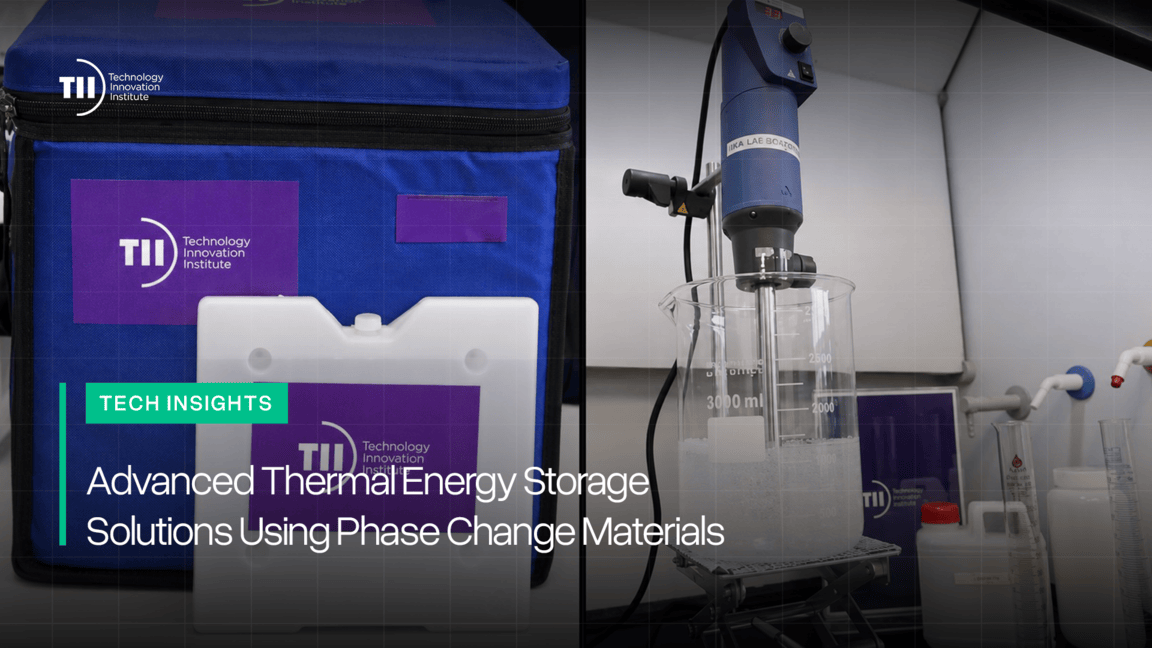
The Advanced Materials Research Center (AMRC) at the Technology Innovation Institute (TII) has built a PCM capability spanning formulation chemistry, thermal modelling and system integration engineering. For example,the cold-chain PCM formulation delivers latent heat in excess of 230 J/g with a melting onset of 3°C. It holds a 2 – 8°C payload envelope for more than 120 hours and tested for 375+ continuous charge and discharge cycles, equivalent to more than seven years of operational service.
This whitepaper sets out the underlying technology, the validated evidence base, the development pipeline and the engineering capability that supports it.
1. The Thermal Challenge in a High-Ambient Economy
The UAE’s thermal environment is not a seasonal inconvenience. It is a structural cost embedded in almost every sector of the economy, and it manifests in four distinct ways.
Cooling as a systemic grid load
Cooling demand in the Emirates is both extreme and highly concentrated. On the hottest summer days, air conditioning can consume up to 80 percent of electricity delivered in Abu Dhabi. The result is an infrastructure paradox: substantial generation, transmission and chiller capacity is procured to serve a narrow annual peak, then sits underutilized. Commercial building operators face the same problem at asset level, oversizing chiller plant to meet a load profile they encounter for only a few hours each year.
Reducing the peak is therefore more valuable than reducing average consumption. Any technology that can decouple the moment cooling is generated from the moment it is consumed delivers disproportionate benefit to grid stability, capital efficiency and emissions.
Cold-chain integrity
Temperature-sensitive goods move through an environment that is actively hostile to them. Pharmaceuticals and vaccines, blood and biological samples, dairy, fresh produce and seafood all require narrow temperature envelopes maintained continuously across road, air and sea transport, through customs delays, traffic congestion and last-mile handover. Active refrigeration answers this at high energy cost and with a single point of failure: when power or the compressor stops, the envelope collapses. Growth in e-commerce and same-day delivery expectations has compressed margins while raising the compliance burden under Good Distribution Practice and equivalent pharmaceutical regulation.
Human heat exposure
Outdoor and industrial workers in agriculture, construction, oil and gas, delivery and mobile users, and primary metals face ambient conditions that regularly exceed 45 – 50°C, and considerably higher near furnaces and process equipment. The protective equipment that keeps them safe from other hazards — flame-resistant coveralls, helmets, encapsulated suits and closed-circuit breathing apparatus — traps metabolic heat and accelerates heat strain. In humid coastal conditions with dew points in the high twenties, evaporative sweat cooling, the body’s primary defense, becomes substantially less effective. Conventional cooling fabrics that perform in dry heat fail here.
Computational density
Artificial intelligence and high-performance computing have raised rack power densities faster than data center cooling architectures have adapted. Thermal stability is now directly coupled to compute performance, hardware lifetime and uptime. The UAE climate compounds this: there is effectively no free cooling window, and mechanical cooling must run continuously. Transient thermal spikes, chiller cycling and cooling lag translate into fan ramping, thermal throttling and reduced hardware reliability.
2. Latent Heat as an Engineering Asset
Conventional thermal mass stores energy as sensible heat: the material warms as it absorbs energy, and its temperature rises continuously. A phase change material instead stores energy as latent heat. As it reaches its melting temperature, it absorbs substantial energy while its own temperature remains effectively constant until the transition is complete. On cooling, the process reverses and the stored energy is released as the material solidifies.
Two properties follow from this and both are engineering assets. First, energy density: latent heat storage holds far more energy per unit than sensible storage across the same temperature span. Second, temperature stability: the material actively holds a target temperature during the transition rather than drifting through it. A PCM is a thermal buffer that can be tuned to activate at a chosen temperature.
Material families
PCM formulations are selected by transition temperature, latent heat capacity, thermal conductivity, cycling stability, cost and safety. Regionally, feedstock availability for materials is favorable. Natural paraffins, the base chemistry for organic PCM, already sit within the scope of Abu Dhabi’s downstream expansion: the linear alkyl benzene project developed jointly by ADNOC and Cepsa is designed to produce 225,000 metric tons of normal paraffins annually. A domestic normal paraffin stream at this scale converts an imported input for organic PCM manufacture into a sovereign one.
The heat transfer constraint
Storing thermal energy is only half the engineering problem. The energy must also move into and out of the material quickly enough to be useful. Heat transfer is governed by the temperature gradient across the material, its thermal conductivity and the available surface area.
This is where high-ambient deployment differs from temperate deployment. In cooler climates, the gradient between a PCM and its surroundings is large, so heat moves readily even through a material of modest conductivity. In the UAE, the ambient temperature is close to many useful transition points, the gradient is small, and the same heat flux must be achieved by other means. Three levers remain: raise the thermal conductivity of the material, increase the heat transfer surface area, and place the PCM closer to the heat source.
AMRC addresses the first through formulation chemistry, nano-additives as conductivity enhancers dispersed within the PCM matrix, and the second and third through system-level design: thermal modeling, encapsulation geometry, and heat exchanger integration.
The operating principle in a high-ambient climate
A second climate-specific consequence is night-time cooling. In temperate regions, PCM systems are frequently charged passively by cool night air and discharged during the day. In the UAE, with night-time temperatures above 30°C, passive overnight solidification cannot be relied upon.
This changes the value proposition. In UAE conditions, PCM is deployed as an actively managed thermal buffer, charged by the chiller or cooling loop during off-peak hours or periods of low load and discharged during peak. The benefits are peak shaving, temperature stability and operational resilience.
3. Proven Capability in Cold-Chain Logistics
The AMRC PCM program began with a defined commercial requirement. AD Ports sought a passive means of maintaining temperature-sensitive cargo within specification through extended transit and handling, without dependence on continuous refrigeration.
Operational value
Risk mitigation: Temperature is held through customs delays, transit disruption and power interruption. Compliance with Good Distribution Practice and pharmaceutical regulation is easier to evidence and validated shipping lanes and qualification protocols are supported.
Operational efficiency: Thermal autonomy is extended through last-mile delivery, and multi-modal movement across air, sea and road is simplified because the packaging carries its own thermal envelope.
Cost optimization: Passive shipping displaces active refrigeration on short and medium routes, reducing energy cost and fleet requirements. Reusable systems lower long-term packaging cost and payload efficiency improves through reduced dry ice handling and a lighter compliance burden.
The formulation is in use or under evaluation across pharmaceutical transport for medications and vaccines, blood and biological sample movement, food logistics covering dairy, fresh produce, seafood and frozen goods, hospital and interdepartmental distribution, last-mile e-commerce delivery, and temporary or contingency storage during infrastructure failure.
4. Applications in Development
The material platform, characterization capability and integration engineering developed for cold chain transfer directly to other thermal problems.
HVAC and district cooling thermal batteries
The largest thermal opportunity in the Emirates is the cooling peak itself. A PCM thermal battery integrated behind the meter charges during off-peak hours or when solar generation is available, then discharges during the afternoon peak to reduce chiller load and grid draw.
The distinguishing feature against incumbent ice storage is temperature. A PCM formulated to melt in the 8 – 12°C range is directly compatible with a standard chilled water plant. No subzero equipment, no glycol loop and no specialized chiller are required, which removes most of the capital and integration barriers that have limited ice storage uptake in commercial buildings.
Wearable and personal cooling
PCM offers a route to personal cooling that functions independently of humidity, which is the failure mode of evaporative approaches in coastal Gulf conditions.
Cooling vests and PPE innerwear: A lightweight liner worn beneath standard protective equipment, impregnated or laminated with PCM tuned close to skin temperature, absorbing metabolic heat before core temperature rises into the danger range. The garment is charged in air-conditioning at shift start.
Head and wrist bands: PCM capsules with a transition point near 21 – 28°C placed over major surface arteries, combined with an evaporative outer shell for dual-mode operation.
Closed-circuit breathing systems: PCM modules integrated as passive thermal buffers within closed-circuit self-contained breathing apparatus used by hazardous-materials and emergency response teams in the energy sector and comparable operating environments.
Data centers and high-density electronics
PCM enters the data center as a buffer within an actively managed cooling architecture, not as a replacement for it. Applied correctly, it absorbs transient spikes, damps chiller cycling, and provides thermal ride-through during cooling interruption.
Integration formats under assessment include PCM-integrated server rack doors for high-density AI and GPU clusters, ceiling panels for large halls and hyperscale retrofits, raised floor systems for traditional facilities, cold plate backup for critical infrastructure, and facility-scale thermal battery arrays. The consistent design principle is that PCM must be actively recharged by the cooling loop; in this climate it cannot rely on ambient recovery.
The built environment
Integrating PCM into building fabric shifts thermal load away from mechanical cooling and improves indoor comfort stability. This spans building envelope and roof integration, ceiling and wall systems, thermally insulating coatings, and photovoltaic panel cooling, where holding cell temperature down directly protects conversion efficiency and panel lifetime.
Another target is urban surfaces. Micro-encapsulated PCM incorporated into asphalt, formulated to transition near peak pavement temperatures of 45 – 65°C, absorbs solar gain during the hottest hours and lowers peak surface temperature. This addresses urban heat island intensity, pedestrian safety, and thermal cracking simultaneously.
Specialized and emerging systems
Compact platforms and space systems: An additively manufactured lattice heat sink with integrated PCM casing, developed for CubeSat electronics. Complex internal lattices and minimal-surface geometries raise effective conductivity and surface area simultaneously; waste heat is absorbed by the PCM and conducted through the meta lattice, then re-radiated during eclipse. The same architecture — a passive, no-moving-parts thermal buffer in a severely volume-constrained envelope — applies to other compact high-value platforms operating in demanding environments.
Marine and maritime: Applications include reefer and ship cold-room stability through power fluctuation, marine battery thermal management where preventing thermal runaway without active cooling is a safety-critical requirement, waste heat recovery aboard efficiency-optimized vessels, and PCM integration into cabin walls, ceilings, and HVAC to add thermal inertia and reduce chiller load. With no moving parts, PCM-based thermal storage increases reliability and resilience in harsh maritime conditions.
Industrial waste-heat recovery: A latent thermal storage system acting as a thermal bank for primary metals production. Surplus heat from aluminium die casting and steel process cooling is captured, stored, and transferred via thermal oil to preheat raw ingots before melting. The core problem is temporal mismatch: waste heat supply is intermittent and preheating demand is continuous. Latent storage bridges the two.
Solar-powered containerized storage: Modular container systems combining photovoltaic generation with PCM thermal storage to hold agricultural yield at 10 – 12°C, covering non-solar hours and enabling decentralized last-mile fresh produce storage with reduced grid dependence.
Battery and drone thermal management: PCM packs integrated around cells to hold optimal operating temperature, extend cycle life and suppress thermal runaway risk without parasitic cooling power.
5. Strategic Alignment and Outlook
PCM technology sits at the intersection of several national priorities. It reduces energy consumption and peak grid load, supporting decarbonization and the UAE Net Zero commitment. It strengthens food and pharmaceutical security by making cold chains more resilient and less energy intensive. It improves worker safety in the sectors most exposed to rising ambient temperatures. It supports domestic manufacture through building on a regional paraffin feedstock base and delivers sovereign technical capability in a field where the alternative is dependence on imported systems designed for foreign climates.
PCM performance is climate specific. A material and system architecture optimized for European or North American conditions will underperform in the Gulf, because the assumptions that govern its charging cycle do not hold here. Formulations and integration strategies developed against UAE operating conditions are not a localized version of an existing product. They are a different engineering answer to a different problem, and they are exportable to every other high-ambient market facing the same constraint.
Across all uses, the underlying proposition is consistent. Thermal energy does not have to be consumed at the moment it becomes available and heat does not have to be removed at the moment it is generated. Introducing that flexibility into a system, passively, without moving parts and without continuous power, is what phase change materials do.