






Cement-based materials remain the backbone of global construction
Mohamed Saleh, Director of Technology Innovation Institute, highlights a vital shift for the UAE’s construction industry.
So far, the Middle East construction industry has treated sustainability as a design challenge. We have mastered the art of green architecture through smart glass, efficient HVAC systems, and LEED-certified designs. But while our blueprints are becoming greener, the physical matter we use to realize them has remained stubbornly traditional.
Currently, the UAE is a global leader in ambitious development, but we remain heavily reliant on importing construction materials that weren’t necessarily designed for our specific desert conditions. This creates a supply chain vulnerability and a significant carbon footprint before a single brick is even laid.
Now, we sit at a critical crossroads where the UAE’s ambitious Net Zero 2050 Strategy and Green Agenda 2030 will soon transition to rigid regulatory mandates. To be future-ready, the industry must look beyond the drawing board and into the very molecular structure of our building blocks.
Cement-based materials remain the backbone of global construction. They are reliable, standardized, and deeply embedded in building codes. But they are also carbon-intensive, water-intensive, and increasingly misaligned with future regulatory expectations.
The solution isn’t necessarily to blame the industry for its reliance on cement but to reframe the problem as a materials supply chain opportunity. We have an abundance of raw material that has been overlooked for decades: the 500,000 tons of palm waste generated annually in the UAE.
Much of it is burned or sent to landfill. But if sustainability is to become a requirement rather than a preference, it’s time to start seeing waste products as homegrown building materials. By repurposing this palm waste into high-performance bio-composites, we are creating a circular economy blueprint, while also cleaning up a landfill problem.
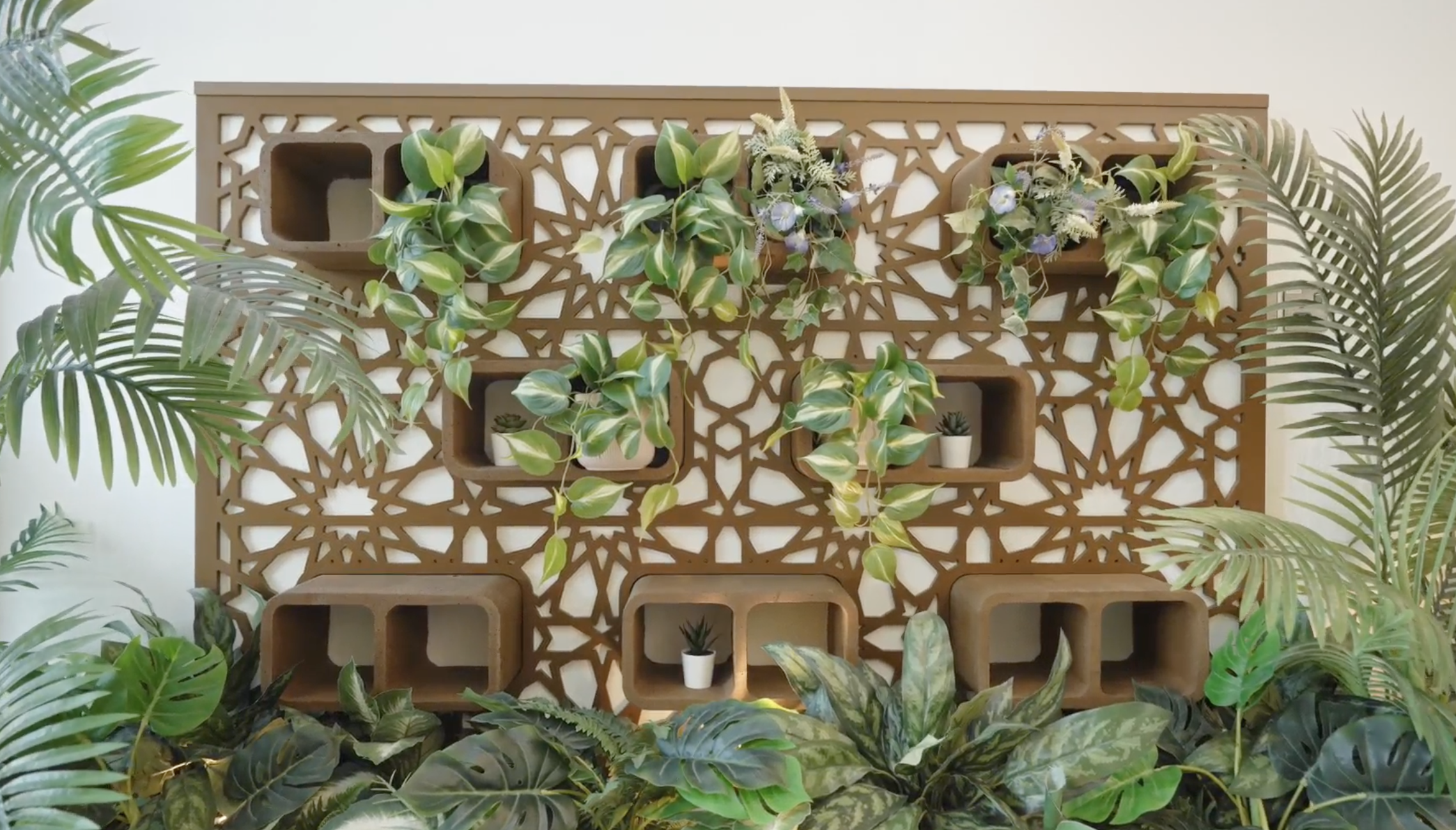
One of the most persistent myths in construction is that “bio-based” means “low-performance.” At the Technology Innovation Institute (TII), we have engineered a material that is three times stronger in compressive strength than standard cement blocks; significantly lighter, reducing structural load and simplifying the logistics of modular construction; and superior in insulation, offering up to four times the thermal performance of traditional concrete. This is not decorative sustainability: this is a high-performance structural material engineered that outperforms our existing standard building materials.
Most importantly for a water-scarce region, this material uses a polymer binder rather than water during production. Making traditional concrete is a thirsty enterprise and then, while standard concrete is water-resistant, it is not waterproof, and will absorb rain, humidity, or groundwater with an absorption rate of up to 15 percent. Our bio-composite has near-zero water absorption, a superior choice for coastal luxury developments where the humidity can degrade buildings.
Then there’s the modular efficiency. We’re not comparing bricks to blocks here. Luxury developers care about speed-to-market, and so do we. Our interlocking design allows for rapid dry assembly, reducing the need for mortar. This is an efficient, high-tech construction system that shortens timelines. The sustainability advantage doesn’t stop at installation: Because the components lock together, they can be disassembled without damage and reused elsewhere, extending material life cycles and embedding circularity directly into the structure itself.
The biggest hurdle to this material revolution, however, is not technology or cost — or even mindset. It’s regulation. Construction codes are notoriously (understandably) rigid, often requiring specific thicknesses or compositions that were written for 20th-centure cement. New materials must pass strict certification pathways before adoption: To introduce a new material, it must undergo standalone testing, performance reporting, factory certification, and regulatory approval.
This is why the first wave of applications for bio-composites is likely to focus on non-structural elements, such as cladding, facades, or modular panels. In these use cases, sustainable materials can immediately reduce embodied carbon without disrupting regulatory frameworks. Plus, we’ve made more than just another brown brick: we have an architectural canvas that allows designers to achieve both modern and traditional aesthetics with effortless shaping and diverse textures, colors, and finishes.
While the UAE’s palm waste provides the immediate proof of concept, the underlying chemistry of our material is designed for global scale. The future of green construction isn’t a one-size-fits-all material shipped across oceans; it’s the ability to adapt to the waste profiles of specific regions. Our approach can be applied to rice husks in Egypt, oil palm residues in Malaysia, or banana stem waste in Indonesia, for example. We’re offering a framework for future-circularity, where every country can use its own unique constraints to build a sustainable future.
Government mandates for sustainable materials are coming. Developers who wait for these laws to be enacted before seeking alternatives will find themselves lagging in a competitive, luxury-driven market. By adopting homegrown, high-performance materials now, the UAE construction industry can lead the global “green revolution” rather than just participate in it. It’s time we stop thinking about what we can build and start thinking about what we are building with.